Skip to content

It drafts. A person decides.

The AI assistant is an optional part of AviSMS that writes first drafts inside the modules you already use: measures for an occurrence, the Five Whys of an investigation, a safety bulletin, the reference to the paragraph of your own Operations Manual that applies, and a draft report read out of a form somebody filled in on paper. Nothing it produces is a record until a named person accepts it, and it never sends anything to your competent authority.

Optional add-on. €49 a month, €29 for training organisations. Included in every 60-day trial.

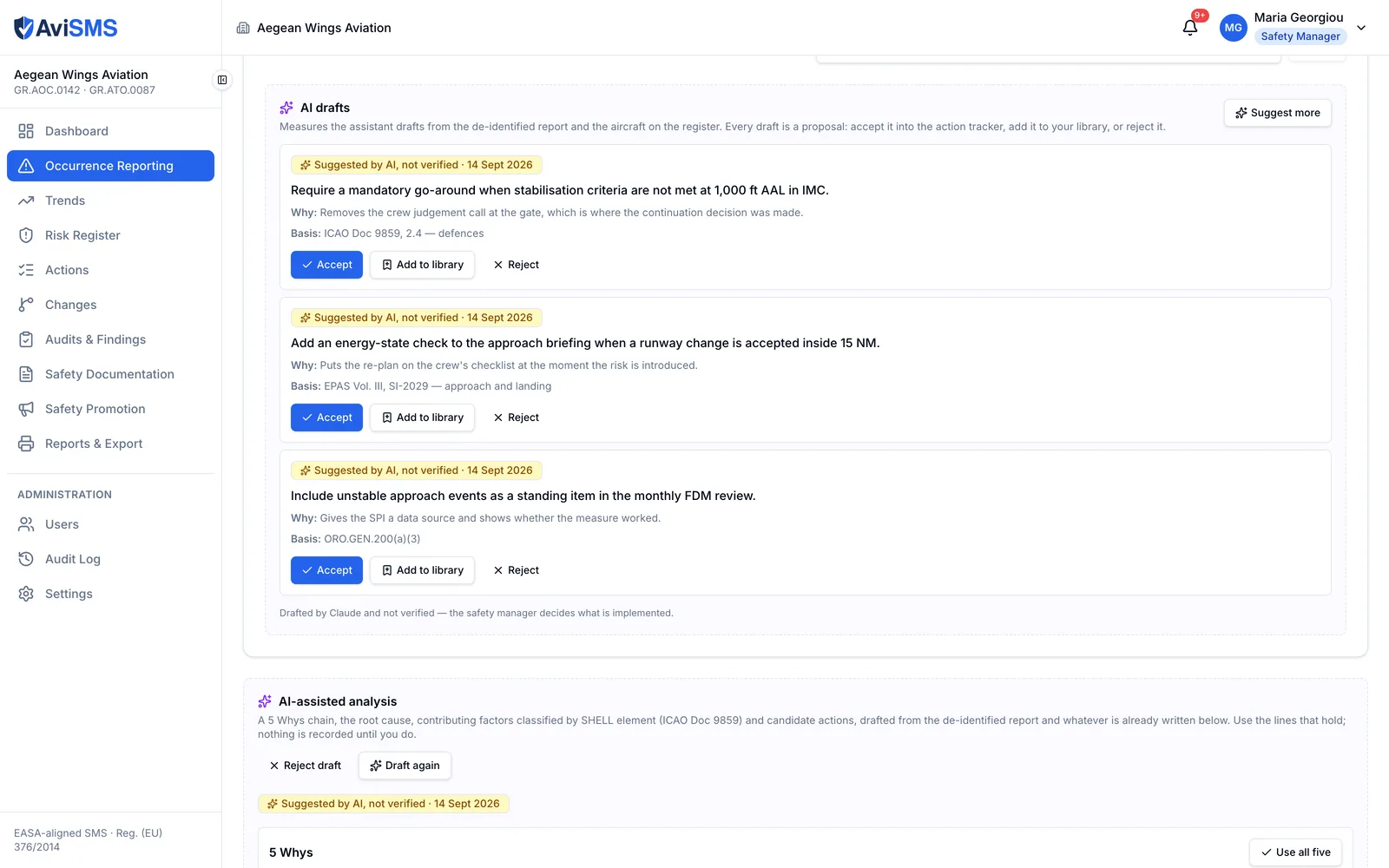
Three drafted mitigation measures inside an occurrence, each labelled “Suggested by AI, not verified” with the reason and the reference it rests on, and Accept, Add to library and Reject buttons.
Measures drafted for an unstable-approach report. Each carries the reason and the basis it rests on, and nothing is stored until someone presses Accept.

What it drafts.

Six places in the application where the blank page is the slow part. Each one is a button next to the field it fills, not a chat window somewhere else.

Occurrence · risk register

Mitigation measures

Given the occurrence type, a de-identified narrative, your fleet and your own mitigation library, it proposes measures with the reason for each and the reference it rests on. You accept them one at a time, and each becomes a tracked action with an owner and a due date.
Occurrence · investigation

Investigation

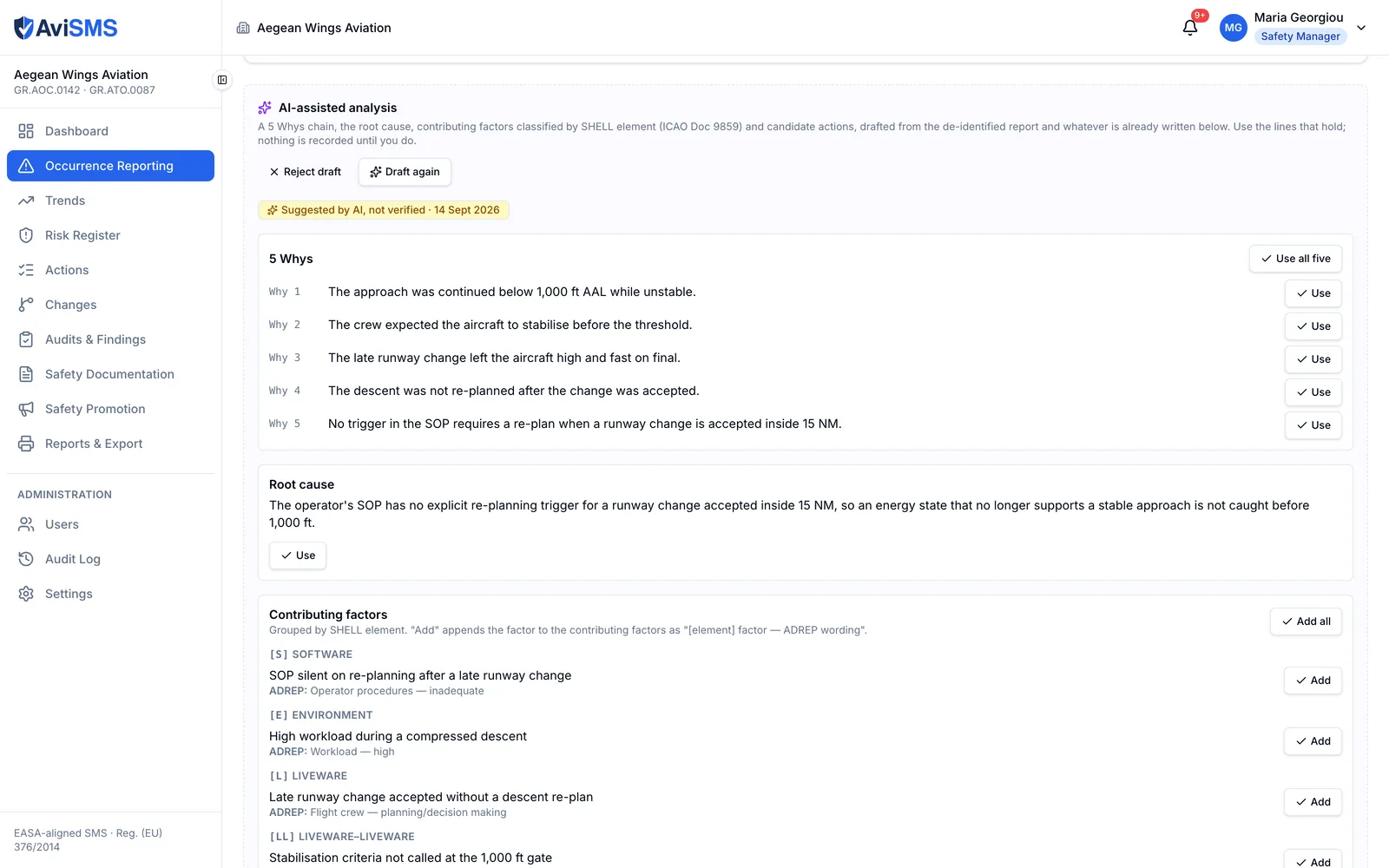
A Five Whys chain, a candidate root cause, and contributing factors classified against the SHELL model and mapped to the ADREP explanatory factors — the vocabulary the authority's own taxonomy uses. Line by line, accepted or discarded by the investigator.

Safety promotion

Safety bulletins

A bulletin drafted from the period's own occurrences and your aircraft types — what we saw, why it matters now, what to do — saved as a draft notice that no member can see until the safety manager publishes it. A month-by-month calendar suggests the topic: bird and wildlife activity in March, thunderstorms and windshear in May, winter operations and de-icing in October, low visibility and fog in November.

Findings · hazards · changes

References into your manuals

Each manual is indexed once per revision. Writing a finding, ask for references and it returns the section and the page — OM-A 8.3.2, page 214 — with the sentence it relied on. An Open page button shows you that page of the PDF so you can check it before you accept it.

Occurrences

A report from a document

Upload the report somebody filed on paper or in an email — a PDF or a photo — and it extracts the fields into a draft occurrence with the uncertain ones flagged. You review the table beside the document and submit it, or you do not.

Settings · forms

Your own forms, made fillable

10 standard forms come in the AviSMS layout with your logo on them. Upload your company's own version instead — a PDF or a scan, up to 30 MB — and it reads the layout: sections, tables, labels, field types and options. AviSMS rebuilds it as a clean fillable PDF you can download blank for the crew room or pre-filled from a record, and the same layout drives the web form. You can correct any field before it is saved.

A drafted investigation: a five-step Why chain, a candidate root cause, and contributing factors grouped by SHELL element with their ADREP wording, each with its own Use or Add button.
The same occurrence, analysed. Contributing factors are grouped by SHELL element and carry the nearest ADREP wording; the investigator takes the lines that hold and leaves the rest.

What it does not do, and cannot.

The limits below are properties of how the feature is built, not promises about how it will be used.

It never writes a record on its own

Every draft appears with the label “Suggested by AI, not verified”. Accepting it stores who accepted it and when, and the record's author is that person. Nothing is stored before that, in any module.

It classifies nothing and closes nothing

The ERCS grade, the risk score, the finding level, the decision to close an occurrence and the approval of a change are all human decisions. No draft touches them.

It files nothing with an authority

AviSMS does not transmit to ECCAIRS 2 at all, with or without the assistant. The E5X package and the PDFs are yours to upload.

Reporters are de-identified before anything is sent

Names, email addresses and the identity behind a confidential report are stripped from the text before it leaves the server, and only the fields a feature needs are sent at all.

Your manuals stay yours

A manual is read to build its section index and to answer a reference question. It is your document, held under the same terms as the rest of your data, and it is not used to train anything.

You can see what it cost

Every call is recorded per organisation and month — how many actions and how many tokens — and shown in Settings. Fair use is 200 AI actions a month; ask if you routinely need more.

How it runs

The parts of the answer an auditor or an IT department asks for.

How it runs
QuestionAnswer
Where does it run?Server-side functions in Google Cloud europe-west1 (Belgium), the same region as the rest of your data. The browser never holds a key.
Which model?Claude, from Anthropic, called by AviSMS on your behalf. You do not need an account with anyone.
What is sent?Only the fields the feature needs, de-identified: an occurrence narrative without its reporter, a section index rather than a whole manual, the form you uploaded.
Who can use it?Whoever can already do the work — the safety manager, an administrator, an investigator. It adds no permission and removes none.
Can we turn it off?It is an add-on: not bought, not present. Bought and unwanted later, it comes off the subscription and the buttons disappear.
What does it cost?€49 a month for an AOC holder or a Part-145, Part-CAMO, aerodrome or ANSP organisation, €29 for an approved training organisation. Included in every 60-day trial.

Try it on your own occurrences.

Every 60-day trial has the assistant switched on from the first day, so what you evaluate is the whole product. Create your organisation and file one report to see what it drafts.